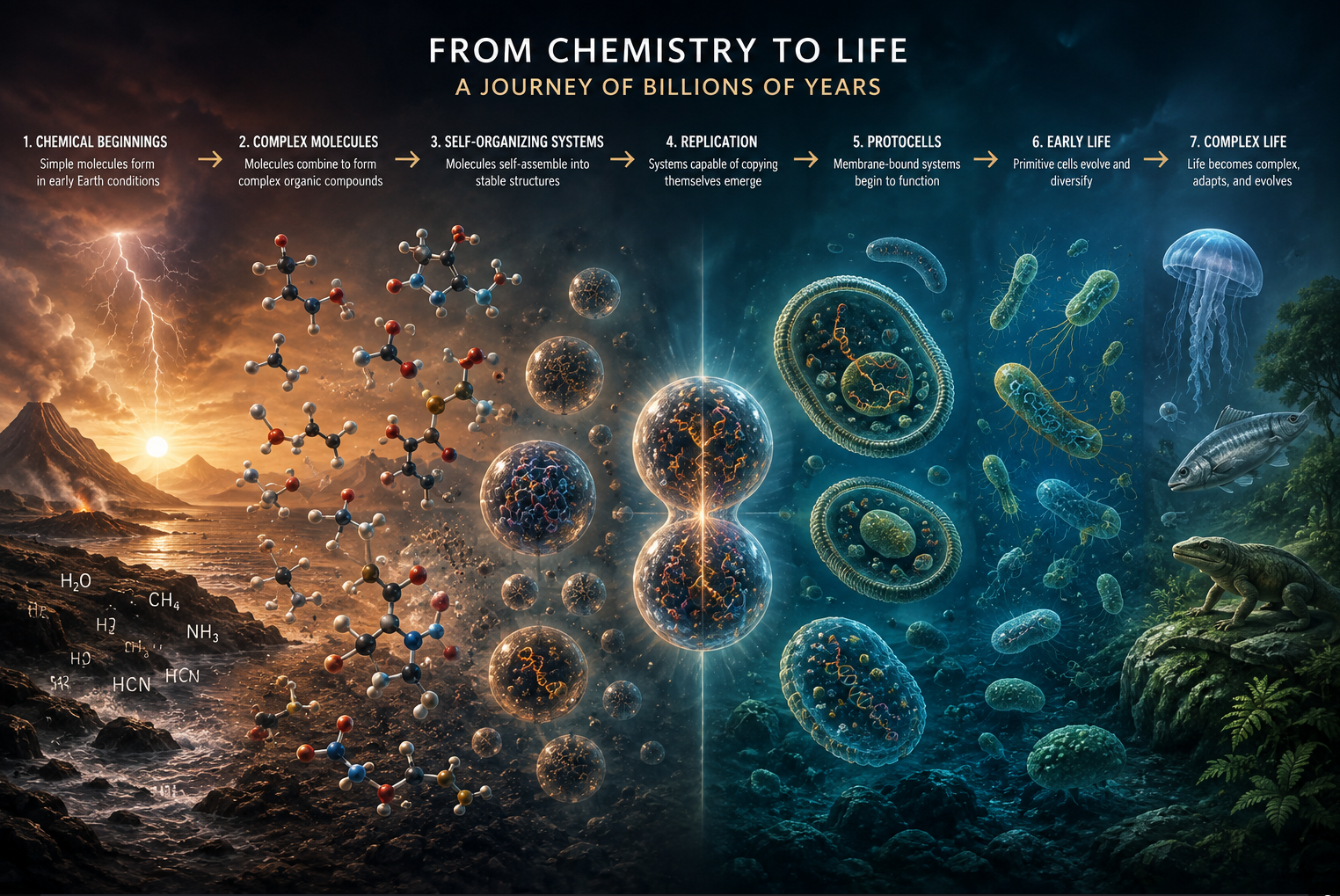
From Chemistry to Life
One of the most fundamental questions in science is:
How did non-living matter give rise to life?
Modern organisms are extraordinarily complex. Cells contain molecular machinery, DNA stores biological information, proteins perform specialized functions, and living systems continuously exchange matter and energy with their environment.
But none of this tells us how the first biological systems appeared.
One possibility being investigated by origin-of-life research is that the transition from chemistry to biology was gradual rather than sudden.
A World of Chemical Possibilities
Early Earth contained water, minerals, gases, organic compounds, energy sources, and environments capable of driving chemical reactions.
Chemical reactions can produce different products depending on their conditions. Over immense periods of time, many different molecules and molecular structures could therefore have formed.
Most would not have persisted.
But some chemical systems may have possessed properties that allowed them to remain stable, interact with their surroundings, or produce structures resembling themselves.
This raises a crucial possibility:
Could increasingly organized chemistry eventually produce systems capable of self-maintenance and replication?
From Replication to Evolution
Replication would represent a major transition.
If a replicating system produced imperfect copies, those copies could differ from one another. Some variations could persist or reproduce more successfully than others.
Over many generations, this creates the fundamental ingredients of Darwinian evolution:
replication + variation + selection.
From there, increasingly complex biological systems could emerge over enormous timescales.
A simplified conceptual pathway is:
Chemistry → complex molecules → organized systems → replication → variation → natural selection → complex life
This is a conceptual framework, not a confirmed reconstruction of the exact historical sequence.
Reproduction Became More Complex
The earliest replicating systems would not have resembled modern animals.
Sexual reproduction, specialized reproductive cells, male and female organisms, and the complex biological drives associated with reproduction evolved much later.
The reproductive systems we see today are products of an extremely long evolutionary history.
And What About Consciousness?
This leads to another profound question.
If biological complexity developed gradually, could consciousness also have emerged gradually?
Perhaps the ability to sense, respond to the environment, process information, and eventually experience the world developed alongside increasingly sophisticated biological systems.
Or perhaps consciousness requires something we do not yet understand.
At present, we do not have a definitive answer.
The Unanswered Beginning
We understand many mechanisms of chemistry and evolution, yet the precise transition from non-living chemistry to the first evolving biological system remains unresolved.
That uncertainty is not a weakness of the question.
It is precisely what makes the origin of life one of the most fascinating problems in science.
At AevonCorp, we are interested in questions where the known ends and the unknown begins.
Understanding life may ultimately require us to understand the transition from chemistry to information, from information to replication, and from replication to evolution.