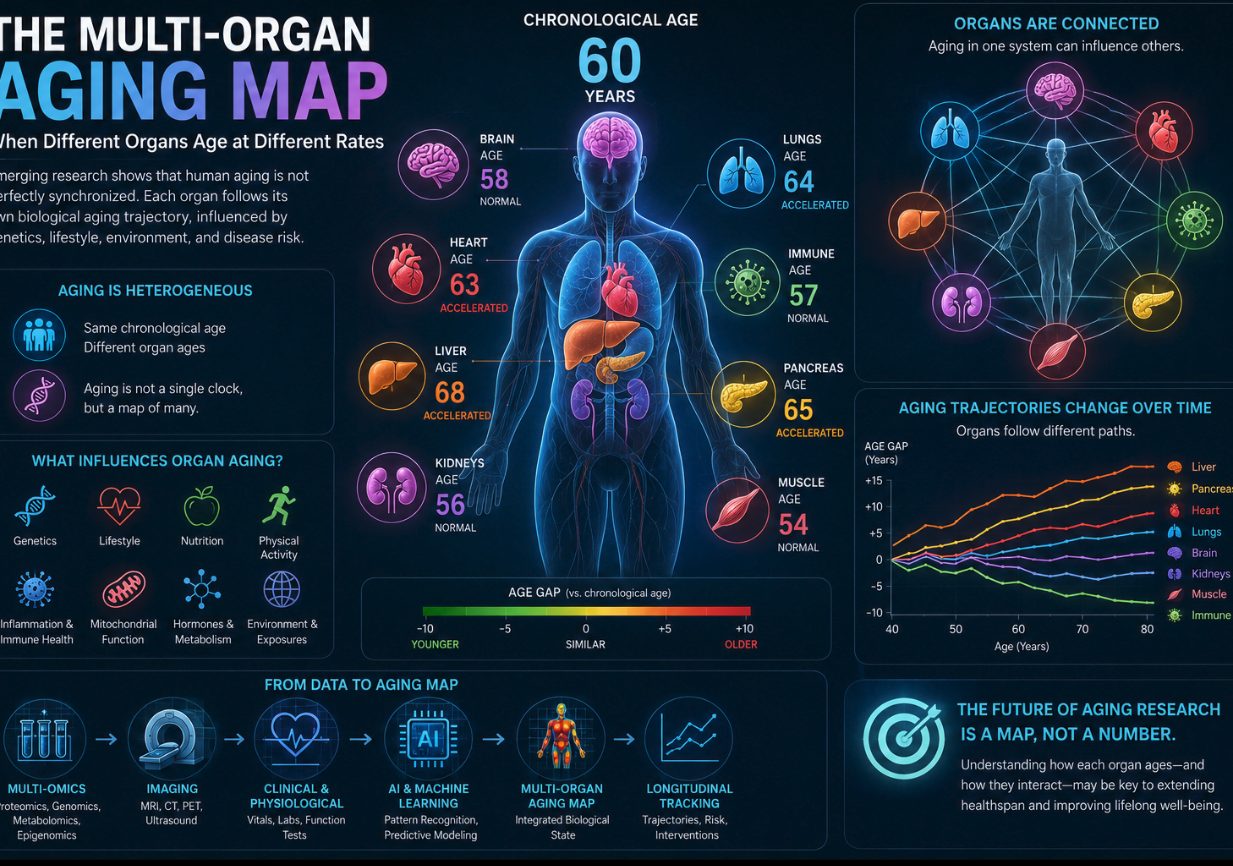
The Multi-Organ Aging Map: When Different Organs Age at Different Rates
A person's chronological age is simple to measure: it is the number of years since birth.
Biological aging is considerably more complicated.
Two people of the same chronological age can have very different patterns of physiological function, molecular change and disease risk. Increasingly, research suggests that this heterogeneity exists not only between individuals, but also within the same individual across different organs and biological systems.
The brain, heart, liver, kidneys, pancreas and other organs do not necessarily follow identical aging trajectories.
This emerging field of research raises an important question:
What if biological age is not a single number, but a map?
Recent advances in imaging, proteomics, genetics, metabolomics and machine learning are making it possible to estimate biological aging at the level of individual organs. Researchers are beginning to use these measurements to study how organs age independently, how they interact, and how their combined aging patterns relate to health and disease.
Chronological age is only one dimension of aging
Chronological age tells us how long a person has been alive.
It does not directly tell us how quickly every biological system has changed during that time.
For example, two people who are both 60 years old could have substantially different biological characteristics across their organs. One might have relatively preserved brain-related measures but greater age-associated changes in the cardiovascular or metabolic systems. Another person of the same chronological age could have a different pattern.
This does not mean that an organ literally has a separate chronological age.
Instead, researchers can develop statistical models that estimate an organ-specific biological age from measurable characteristics.
An organ-age estimate therefore represents how closely the observed biological features of an organ resemble patterns associated with different ages in a reference population.
This distinction is important.
An estimated "liver age" of 65 in a 55-year-old should not be interpreted as meaning that the liver is literally ten years older. It represents an age-related deviation produced by a statistical model.
Evidence that organs age asynchronously
Research over the past several years has provided evidence for heterogeneous aging across organ systems.
A 2023 Nature Medicine study developed biological-age measures across multiple brain and body systems using imaging and physiological data. The researchers found substantial heterogeneity in biological aging and evidence of relationships between aging across different systems.
Another large Nature study used plasma proteins to estimate the biological ages of 11 organs in thousands of people. The study found considerable variation between organ-specific age estimates. This provided evidence that individuals can exhibit accelerated aging in particular organs rather than experiencing identical aging across the entire body.
More recent work has expanded this approach using much larger datasets and additional biological measurements.
A 2025 Nature Aging study developed organismal and ten organ-specific proteomic aging clocks using plasma proteins from more than 43,000 UK Biobank participants and validated the models in additional cohorts from China and the United States. The study reported associations between accelerated organ aging and disease and mortality outcomes.
Together, these findings support an increasingly important idea:
Human aging is heterogeneous and asynchronous.
From one biological clock to multiple clocks
Traditional biological-age research often attempts to estimate a person's overall biological age.
Biological clocks can use different types of information, including:
- DNA methylation
- clinical measurements
- blood biomarkers
- proteins
- metabolites
- imaging features
- physiological measurements
- genetic information
Each approach captures a different aspect of biological aging.
Organ-specific clocks take this concept one step further.
Instead of asking only:
"How old is this person biologically?"
researchers can ask:
"How old does each biological system appear relative to appropriate reference populations?"
This produces a multidimensional representation of aging.
Conceptually:
Whole-body biological age
can become:
Brain aging + cardiovascular aging + liver aging + kidney aging + metabolic aging + immune aging + other system-specific measures
The objective is not to replace whole-body measures, but to determine whether additional organ-specific information provides a more informative representation of biological aging.
The rise of imaging-based organ clocks
Imaging is particularly interesting because it provides information about biological structure and, in some cases, functional characteristics.
A 2026 npj Digital Medicine study developed imaging-based organ-specific aging measures using imaging-derived phenotypes and investigated relationships with disease and mortality. The researchers reported both shared and organ-specific molecular signatures associated with organ aging.
Another major 2026 Nature Medicine study developed seven MRI-based biological age gaps for the:
- brain
- heart
- liver
- adipose tissue
- spleen
- kidney
- pancreas
The study used data from more than 300,000 individuals and connected the imaging-derived aging measures with thousands of plasma proteins, metabolites and millions of genetic variants. The analysis identified both organ-specific and cross-organ relationships.
This is an important development because it illustrates how different biological data layers can be connected.
Imaging provides structural information.
Proteomics provides information about proteins circulating through the body.
Metabolomics provides information about metabolic state.
Genetics provides information about inherited variation.
Together, these measurements can provide a richer representation of biological aging than any single measurement alone.
The body is an interconnected aging network
Organs do not function as isolated components.
The cardiovascular system interacts with the brain, kidneys, liver and other tissues. Metabolism influences multiple organs. Immune and inflammatory processes can affect tissues throughout the body.
Consequently, organ-specific aging should not be interpreted as completely independent.
The emerging concept is a multi-organ aging network.
Recent research and reviews have highlighted evidence for both organ-specific aging patterns and relationships between aging across organs.
However, an important scientific distinction must be maintained.
An association between the aging of two organs does not automatically demonstrate that aging in one organ causes aging in the other.
Cross-organ relationships may arise from shared genetics, systemic metabolism, vascular processes, immune signaling, environmental exposures, lifestyle factors or other biological mechanisms.
Determining causality requires stronger longitudinal and experimental evidence.
Why do organs age at different rates?
There is no single explanation.
Different organs have different:
Cellular compositions
Organs contain different proportions of specialized cell types, each with their own vulnerabilities and responses to aging.
Metabolic demands
The energetic requirements and metabolic functions of the brain, heart, liver and kidneys are very different.
Regenerative capacity
Tissues differ in their ability to replace damaged or dysfunctional cells.
Exposure to physiological stress
Mechanical, metabolic, oxidative and environmental stresses can affect tissues differently.
Vascular environments
Changes in blood vessels can influence the supply of oxygen and nutrients to multiple organs.
Genetic influences
Genetic variants can influence aging-related traits, sometimes in organ-specific ways.
Environmental and lifestyle influences
Diet, physical activity, smoking, sleep, metabolic health and other exposures can affect multiple biological systems throughout life.
Recent multi-omics studies are beginning to investigate these mechanisms across organ systems rather than studying each organ in isolation.
Multi-omics may provide the next layer of resolution
One of the most promising directions is the integration of multiple biological data types.
A conceptual multi-organ aging model could integrate:
Genomics
↓
Epigenomics
↓
Transcriptomics
↓
Proteomics
↓
Metabolomics
↓
Imaging
↓
Physiology and clinical measurements
↓
Organ-specific biological state
↓
Whole-body aging profile
Recent methodological work emphasizes that multi-omics integration could provide more comprehensive information than relying on a single molecular layer. At the same time, significant challenges remain, including differences between measurement platforms, data availability, model generalizability and clinical interpretation.
A map may be more informative than a single number
Consider a hypothetical individual whose chronological age is 60.
Instead of representing that individual only as:
Biological age: 60
a research model could potentially describe a multidimensional profile:
Brain — relative aging pattern
Heart — relative aging pattern
Liver — relative aging pattern
Kidney — relative aging pattern
Pancreas — relative aging pattern
Metabolic system — relative aging pattern
Immune system — relative aging pattern
The value of such a representation would not necessarily be the individual numbers themselves.
The value could come from understanding the pattern.
One person might show relatively preserved aging across many systems but an accelerated pattern in one organ.
Another might show moderate acceleration across several interconnected systems.
These patterns could potentially provide information that is obscured when biological aging is compressed into a single score.
The importance of time
A single measurement provides only a snapshot.
Aging is a process.
Suppose an organ-specific aging model produces an age gap at one point in time. The more interesting question may be what happens during the following years.
Does the gap remain stable?
Does it increase?
Does it decrease?
Does the trajectory change after a major health event?
Longitudinal research is therefore critical.
The 2026 Nature Aging perspective on organ-specific biological clocks specifically identifies longitudinal tracking, organ-specific biomarkers and appropriate reference ranges as important priorities for the field.
This leads to a deeper concept:
The future of biological aging research may involve tracking aging trajectories rather than simply assigning an age.
Toward a dynamic human aging map
A future computational framework could conceptually represent the human body as a dynamic network:
Organ structure
Molecular state
Physiological function
Time
Inter-organ relationships
This would create something closer to a dynamic multi-organ aging map.
Such a framework could potentially help researchers study questions such as:
- Which biological systems show the greatest age-related change?
- Which organs appear to age together?
- Which molecular signatures accompany accelerated organ aging?
- Which patterns are associated with disease?
- How stable are organ-specific aging trajectories?
- Which changes precede measurable functional decline?
- Can interventions alter an aging trajectory?
- Which biological measurements provide the most useful predictive information?
These remain research questions. They should not be interpreted as evidence that such a system is already a clinically validated diagnostic technology.
The role of artificial intelligence
The scale and complexity of multi-organ biological data create a natural role for computational methods and artificial intelligence.
A human biological system can generate enormous amounts of information across imaging, molecular measurements, clinical records and longitudinal observations.
Machine-learning models can help identify patterns within these high-dimensional datasets.
However, prediction alone is not enough.
A useful aging model must also be carefully validated, calibrated and tested across different populations and measurement settings.
Recent work on multi-organ aging clocks has specifically highlighted issues such as age-related bias, organ specificity of biomarkers, sample composition, underlying disease and model generalizability.
Therefore, the scientific challenge is not simply:
"Can AI predict age?"
It is:
"Can computational models reliably characterize meaningful biological changes across organs and over time?"
A possible future framework for Aevon's research direction
The emerging literature suggests a conceptual architecture for studying human aging:
Human anatomy
→ Organ-specific measurements
→ Multi-omics
→ Biological state
→ Inter-organ relationships
→ Longitudinal aging trajectories
→ Healthspan and disease outcomes
This is not a claim that Aevon has already developed such a system.
Rather, it represents a research direction that connects advances in aging biology, computational biology, medical imaging and artificial intelligence.
From an aging clock to an aging map
The most important shift may therefore be conceptual.
Aging may not be adequately represented by one number.
It may be better understood as a distributed process occurring across interconnected biological systems at different rates.
The emerging field of organ-specific biological clocks provides one approach to measuring this heterogeneity. Multi-omics and imaging research is expanding the amount of information that can be incorporated into these models, while longitudinal studies may eventually help determine how these biological patterns change across the life course.
The long-term scientific challenge is to move from isolated measurements toward a coherent understanding of the human aging system.
Aevon Perspective
At Aevon Corporation, we consider the development of multi-organ and longitudinal representations of biological aging an important area for future research.
The central question is not simply:
"How old is a person?"
It is:
"How are the different biological systems of that person changing, how are they interacting, and how does that trajectory relate to healthspan?"
Aging may ultimately be better represented not as a single clock, but as a dynamic map of biological states changing through time.
That map could become an important conceptual foundation for future research into human aging, healthspan and biological resilience.
Scientific perspective and limitations
Organ-specific biological aging clocks are an emerging research technology, not established universal clinical measurements.
Different models use different data sources, populations and statistical methods. An estimated organ age should therefore be interpreted as a model-derived measure rather than a literal age of an organ.
Important challenges include validation across populations, longitudinal data, measurement standardization, organ-specific biomarker specificity, causal interpretation and demonstrating that changes in an aging clock correspond to meaningful improvements in health outcomes.
Further research is required before organ-specific aging maps can be considered reliable tools for routine clinical decision-making.
Selected Research
- Zalesky, A., Wen, J. & Tian, Y. E. From whole-body to organ-specific biological age clocks. Nature Aging (2026).
- Organ-specific proteomic aging clocks predict disease and longevity across diverse populations. Nature Aging (2025).
- MRI-based multi-organ clocks for healthy aging and disease assessment. Nature Medicine (2026).
- Imaging-based organ-specific aging clock predicts human diseases and mortality. npj Digital Medicine (2026).
- Wen, J. Refining the generation, interpretation and application of multi-organ, multi-omics biological aging clocks. Nature Aging (2025).
- Vasileiou, M. et al. Multi-Omics Signatures of Organ Clocks in Biological Aging and Disease. Aging Cell (2026).