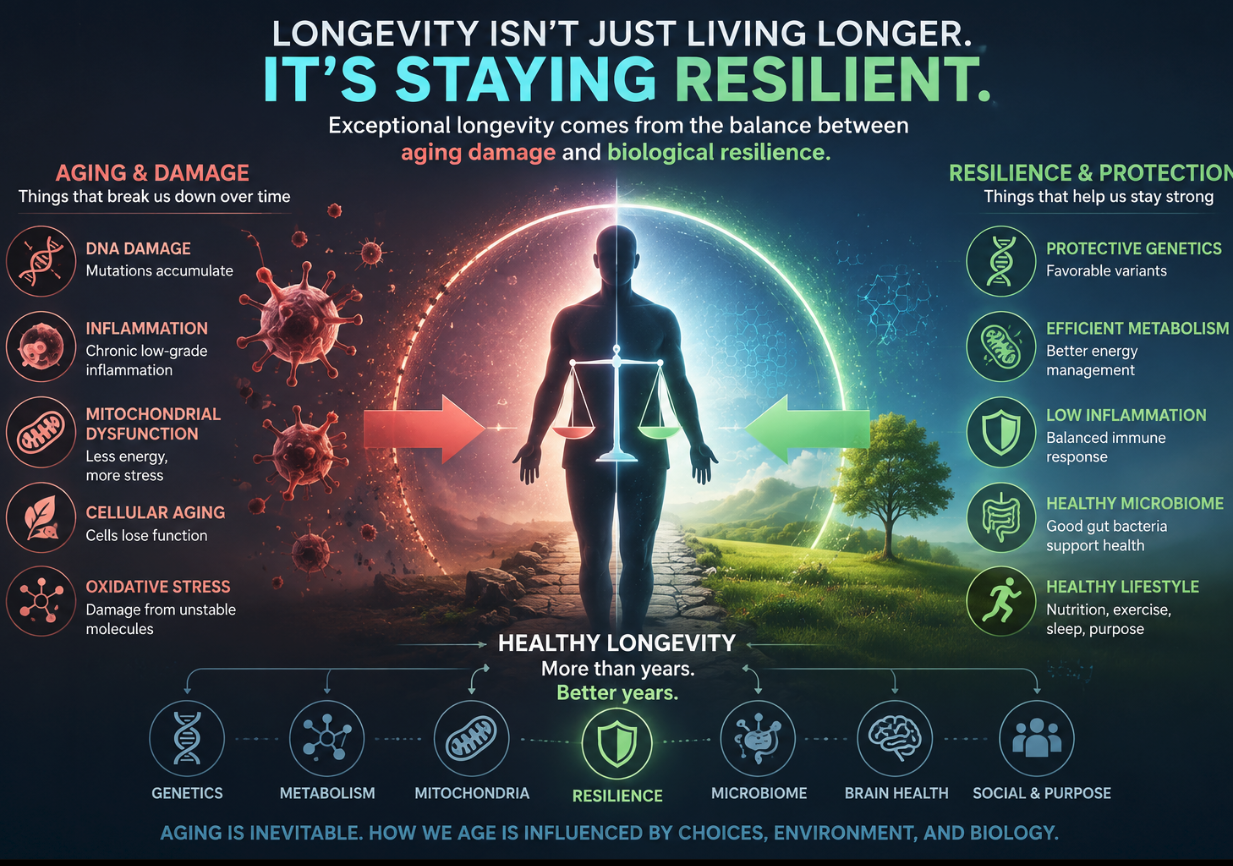
Why do some people remain remarkably healthy into their 90s, 100s, or beyond?
A growing area of aging research suggests that the answer may not simply be that these individuals age more slowly. Instead, exceptional longevity may involve an unusual ability to maintain biological resilience despite the molecular changes associated with aging.
A 2026 commentary published in npj Aging, titled The pursuit of understanding human longevity by Pawel Kordowitzki and Kejun Ying, discusses recent evidence suggesting that exceptional longevity arises from a complex interaction between genetics, metabolism, inflammation, mitochondrial function, the immune system, the gut microbiome, epigenetics, lifestyle, and environmental factors.
This perspective offers an important way to think about aging: longevity may be as much about preserving function as it is about slowing biological deterioration.
Aging does not happen through a single mechanism
Aging is often described using individual processes such as DNA damage, mitochondrial dysfunction, cellular senescence, inflammation, or epigenetic changes. However, the biology of aging is highly interconnected.
The research discussed in the npj Aging article suggests that exceptionally long-lived individuals can display recognizable biological signs of aging while simultaneously retaining protective characteristics.
These characteristics include favorable genetic variants, efficient mitochondrial and metabolic function, lower inflammatory burden, favorable lipid metabolism, changes in the gut microbiome, and relatively preserved epigenetic features.
This creates an interesting biological paradox:
Signs of aging can coexist with strong mechanisms of protection.
Rather than viewing aging as a simple downward trajectory, this suggests that researchers should also investigate how biological systems adapt, compensate, repair, and maintain function over time.
From lifespan to healthspan
Living longer is not necessarily the same as living healthier for longer.
A central question in longevity research is therefore not simply:
“How can we increase lifespan?”
but:
“How can we preserve biological function for a greater proportion of life?”
This distinction is important because many diseases associated with aging—including cardiovascular disease, cancer, and neurodegenerative disorders—become more common as biological resilience declines.
Understanding why some individuals remain resistant to these conditions could therefore reveal mechanisms that are relevant to extending healthspan, not merely chronological lifespan.
The importance of multiple biological systems
Exceptional longevity appears to be influenced by several interconnected systems.
Genetics
Studies of centenarians suggest that protective genetic variants and a lower burden of certain harmful genetic variants may contribute to longevity.
Genetics, however, is unlikely to provide a complete explanation. Environmental conditions, behavior and biological responses interact with genetic predisposition throughout life.
Metabolism
Metabolic regulation is another major component of longevity research.
Pathways involving systems such as mTOR, insulin/IGF, AMPK, FOXO and NAD+ have been investigated extensively in aging biology. Experimental studies across different organisms have demonstrated that altering nutrient-sensing and metabolic pathways can influence lifespan and healthspan.
However, findings from animal models should not automatically be interpreted as proven lifespan-extending interventions in humans.
Mitochondria
Mitochondria play a central role in cellular energy production and metabolic regulation.
Maintaining mitochondrial function may therefore be an important component of biological resilience, particularly as cells experience increasing stress during aging.
Immune function and inflammation
Aging is associated with changes in immune function and inflammatory regulation.
The research discussed in the npj Aging commentary highlights the possibility that unusually effective regulation of inflammatory and immune responses may contribute to healthy longevity.
Epigenetics
Epigenetic patterns change throughout life and can provide information about biological aging.
The observation that some exceptionally long-lived individuals retain relatively favorable epigenetic characteristics raises an important research question:
Can preservation of epigenetic stability contribute to maintaining biological function during advanced age?
The microbiome and longevity
The gut microbiome is another component of the larger aging system.
Research discussed in the article points toward relationships between gut microbial composition, metabolism, inflammation, and healthy aging. Specific organisms and probiotic interventions are being investigated, but these areas remain active research questions rather than established methods for extending human lifespan.
This is an important distinction: association and biological plausibility do not automatically establish a proven longevity intervention.
A systems view of biological resilience
One useful way to interpret these findings is to consider aging as a dynamic systems problem.
Instead of examining one biomarker in isolation, researchers could investigate interactions among:
Genome → Epigenome → Metabolism → Mitochondria → Immune system → Microbiome → Tissue integrity → Organ function → Healthspan
Changes in one component can potentially influence several others.
This systems perspective may become increasingly important as biological datasets become larger and more multidimensional.
What this means for future longevity research
The most interesting implication is that the future of aging research may not depend on finding a single “anti-aging switch.”
Instead, researchers may need to understand why some biological systems remain resilient for decades longer than expected.
That means studying individuals across multiple biological layers and, importantly, observing how those layers change over time.
Multiomics approaches—combining genomic, transcriptomic, epigenomic, proteomic, metabolomic and other biological measurements—could help researchers construct a more complete picture of biological aging.
The goal would not simply be to assign someone an “age” based on one biomarker.
It could be to understand their biological state, vulnerabilities, compensatory mechanisms and resilience across interconnected systems.
Aevon's perspective
At Aevon Corporation, we see this systems-level view as an interesting direction for future research and discussion around aging biology.
Aging is unlikely to be represented adequately by a single number.
A more informative framework may involve understanding how different biological systems change through time—and how those changes ultimately influence tissue integrity, organ function and healthspan.
This perspective raises an important question for future research:
Can biological resilience be modeled, measured and eventually predicted across the human lifespan?
Answering that question will require integration of molecular biology, computational modeling, longitudinal data and increasingly sophisticated biological measurement technologies.
Exceptional longevity provides an especially valuable natural experiment: individuals who reach extreme ages while retaining substantial function may offer clues about the mechanisms that allow biological systems to remain resilient for unusually long periods.
Source
Kordowitzki, P. & Ying, K. The pursuit of understanding human longevity. npj Aging 12, 25 (2026). Published February 5, 2026.
The article discusses findings from recent longevity and multiomics research and emphasizes that precise recommendations for humans to reliably achieve exceptional longevity remain unresolved.
This Aevon article is an independent educational interpretation of the published research and does not claim that the underlying findings were produced by Aevon Corporation.